
 | ||
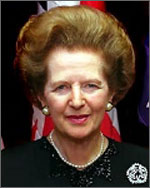
| ▲ 마거릿 대처 | ||
減稅, 정부지출 삭감, 저축 장려 등을 통해 국민들로 하여금 自助정신(Do It Yourself)을 심어 주다.
●「칼리굴라(로마의 폭군)의 눈과 마릴린 먼로의 입을 가진 정치인」(미테랑 前 프랑스 대통령)
● 自手成家한 아버지로부터 自省과 自制, 근면과 성실, 自立을 강조하는 프로테스탄트적 윤리의식을 배워
● 1984~1985년 363일간의 대결 끝에 탄광노조 굴복시켜
●『데탕트의 옹호자들은 평화를 원한다면 전쟁을 준비하지 말아야 하고, 안전을 원한다면 위협을 하지 말아야 하며, 협조를 원한다면 타협을 해야 한다고 말한다. 이런 시각은 全的으로 틀린 것이다』
●『냉전에서 승리를 얻어 낸 것은 우리 반공주의자들이었다. 승리를 얻어 낸 것은 그 누구보다도 로널드 레이건의 공이었다』
「불만의 겨울」
1979년 새해가 밝았을 때 영국인들의 마음은 밝지 못했다. 수년 만에 찾아온 酷寒(혹한)이 사람들의 몸과 마음을 얼어붙게 했을 뿐만 아니라 1978년부터 계속된 자동차, 운수, 병원, 청소 등 사회 기간부문에서 벌어진 장기파업으로 인해 나라 전체에 좌절과 비관주의가 넘쳐나고 있었기 때문이었다.
영국인들이 「불만의 겨울(Winter of Discontent)」이라고 불렀던 그해 겨울은 참담한 상황의 연속이었다. 운송망이 마비됨에 따라 경제활동이 심각한 타격을 입었고, 청소작업이 중단되면서 도시 곳곳에는 쓰레기 더미가 넘쳐나고 있었다.
병원의 파업으로 환자들은 난방도 없는 병실에서 추위에 떨거나 아예 쫓겨나기까지 했다. 노인들은 과연 살아서 이 겨울을 넘길 수 있을지를 걱정했다. 그래도 살아 있는 자들은 형편이 나았는지도 모른다. 노조원들이 시신의 埋葬(매장)과 火葬까지 방해함에 따라 죽은 자들이 갈 곳마저 막혀 버렸던 것이다.
1970년대 영국은 파업으로 해가 뜨고 해가 지는 나라였다. 정부는 勞組를 달래기에 급급해 임금이 급격하게 상승했다. 과도한 복지정책으로 재정적자가 크게 늘어났다. 주요 기업들이 公기업화됨으로써 경쟁력이 약화됐다. 그 결과 경기침체와 인플레이션이 발생하고 실업률이 급격하게 상승했다. 1976년에는 선진국 최초로 IMF로부터 구제금융을 받기에 이르렀다. 사람들은 영국이 처한 상황을「英國病(영국병)」이라는 말로 요약했다.
경제사정이 이 지경에 이르고 있었지만 노동조합의 과도한 요구와 파업은 한없이 계속되고 정부는 속수무책이었다. 1974년 보수당의 히스(E. Heath) 수상은 『이 나라를 다스리는 것이 勞組냐 정부냐』는 말을 남긴 채 실각했다. 뒤를 이어 대화와 타협을 강조하는 노동당 정부가 들어섰지만 勞組의 파괴적인 행위는 멈추지 않았고 「불만의 겨울」이라는 사상 초유의 사태가 발생했다. 이에 노동당의 캘러헌(J Callaghan) 수상은 勞組에게 『이제 국민들이 참는 것도 한계에 와 있다』는 말을 남기고 물러났다.
1979년 5월 실시된 총선거에서 영국인들은 마거릿 대처가 이끄는 보수당을 선택했다. 영국에는 위대한 여왕은 있었지만 여성이 수상직에 오른 적은 없었다. 수십 년 동안 누적돼 온 문제를 53세의 여성 정치인이 해결해 낼 수 있을까?
대처 수상은 여성의 우아한 매력도 가지고 있었지만, 어떤 남성도 따르지 못할 강한 신념과 의지를 지닌 정치인이었다. 프랑스의 미테랑 대통령은 그녀를 『칼리굴라(로마의 폭군)의 눈과 마릴린 먼로의 입을 가진 정치인』이라고 표현했다. 그녀는 온화한 미소를 지으면서도 손에는 예리한 메스를 들고 중병을 앓고 있는 나라를 수술하기 시작했다. 고통이 따랐지만 결과는 매우 성공적이었다. 英國病을 거론하는 사람이 사라지게 된 것이다. 대처는 후일 이렇게 자부했다.
우리가 정권을 맡았을 때 영국은 쇠퇴의 늪으로 빠져들고 있었습니다. 그런 영국을 건져 내기 위해 기업가 정신을 본보기로 삼았으며 흐트러졌던 법과 질서를 바로잡았습니다. 전적으로 부당하게 운영되던 노동조합 문제도 해결했습니다. 노동당 정부下에서 나라가 쇠퇴로 치닫고 있었는데 그 상황을 중단시켰습니다』
아버지에게서 배운 프로테스탄티즘 윤리
철의 여인」으로 불리면서 「대처리즘」이라는 용어를 생겨나게 했던 마거릿 대처는 1925년 10월13일 영국 랭커셔州의 그랜덤이라는 시골 마을에서 태어났다. 그녀는 잡화상을 운영하던 알프레드 로버츠(Alfred Roberts)의 둘째 딸이었는데, 어린 시절 그녀에게 가장 큰 영향을 끼친 사람은 그녀의 아버지였다. 後日 수상이 되었을 때 그녀는 이렇게 회고한 바 있다.
『제가 선거에서 이긴 것은, 그리고 선거 때 호소한 것은 결국 어렸을 때 아버지께서 제게 다 가르쳐 주신 것이었습니다』
알프레드 로버츠는 열세 살 때 학교를 그만두고 그랜덤의 식료품점에서 일하게 되었다. 비록 학력은 높지 않았지만 정열을 가지고 성실히 일했기 때문에 그 가족의 생활은 점차 나아지게 되었고 마침내 잡화상의 주인이 되었다. 또한 지식에 대한 갈망이 커서 각종 책들을 시립도서관에서 빌려 와 끊임없이 읽었다.
그는 교회의 장로가 되었고 딸들이 다니던 학교의 이사가 되었다. 그리고 市의회 의원에 선출되었고 나중에는 그랜덤의 市長까지 되었다. 이렇게 自手成家(자수성가)한 사람의 전형이었던 아버지의 영향으로 마거릿은 自立과 自助 정신의 중요성을 일찍부터 체득하게 되었다.
그녀의 가족은 신실한 기독교(감리교)인이었다. 매주 일요일이면 가게 문을 닫고 예배에 참석했으며 엄숙하고 경건한 신앙생활을 했다. 종교적인 분위기 속에서 그녀는 自省과 自制, 근면과 성실, 自立을 강조하는 프로테스탄트적 윤리의식을 배워 나갔다. 마거릿이 열 살 때까지 함께 생활했던 그녀의 외할머니는 전형적인 빅토리아식 여인으로서 어린 마거릿에게 정직과 소박, 自助정신과 弱者에 대한 보살핌 등 빅토리아 시대의 美德을 가르쳤다.
알프레드는 마거릿에게 어린 시절부터 정치적 경험을 쌓게 했다. 마을에 흥미 있는 연설가가 왔는데 자신이 참석하지 못하게 될 경우 마거릿을 보내 연설을 듣고 요점을 보고하도록 하기도 했다.
1935년 총선거에서 그의 가족이 거국 내각 후보인 빅터 워렌더를 지지하기 위해 선거운동에 나섰다. 이때 마거릿은 고작 열 살의 나이에 처음으로 선거운동, 선거인 명부, 후보지명 등 정치의 기본과정을 경험하게 되었다. 그 후 그녀는 아버지가 市의회에 진출하기 위해 선거운동을 하는 과정에 참여하면서 어린 시절부터 정치에 대한 참여와 경험을 쌓아 나갔다.
학교 시절 마거릿은 학교에서 그리 인기가 있는 편은 아니었다. 그다지 사교적인 성격이 아니었기 때문에 학교에서 친한 친구가 적었던 것이다. 그러다 보니 동급생들로 부터 「야심가」라는 말을 들으면서 따돌림을 당하기도 했다. 그녀의 아버지는 그런 딸을 다음과 같은 말로 격려했다.
『따돌림을 받을까 봐 두려워서 집단에 맹목적으로 따라가서는 안 된다. 네가 할 일은 네가 스스로 결정해야 한다』
급진적 대학 풍토 속에서 「보수주의학생연합」 회장으로 활약
1943년 10월 마거릿은 옥스퍼드大 소머빌 칼리지 화학과에 입학했다. 난생 처음 고향을 떠나 가족과 떨어져 생활하게 된 그녀는 향수병을 이겨내는 가장 좋은 방법은 열심히 공부하는 것이라고 생각하면서 강의실과 실험실을 오고 갔다. 하지만 그녀의 지도교수들은 그녀가 화학보다는 다른 것에 흥미를 가지고 있다는 것을 알고 있었다.
그녀는 「바하 합창단」, 「과학연구서클」, 「감리교학생회」 등에 참여했지만 가장 흥미를 느낀 것은 「옥스퍼드 보수주의 학생연합회(OUCA)」에 가입해 활동하는 것이었다.
마거릿은 1945년 총선에서 보수당을 지원하는 선거운동을 벌였고, 1946년에는 보수주의학생연합 의장으로 선출되었다. 마거릿이 활동하면서 보수주의학생연합은 크게 성장하여 칼리지 내에서 유니온(Union)클럽 다음으로 큰 단체가 되었다. 그녀는 後日 수상이 된 저명한 정치가 안토니 이든 卿(경)을 초청했으며 옥스퍼드 보수주의학생연합의 대표 자격으로 보수당 연석회의에 참석하기도 했다.
학교를 졸업한 후 그녀는 런던에서 100km 정도 떨어진 매닝트리에 있는 플라스틱 회사의 연구원으로 취직했다. 회사 실험실에서 근무하면서 지역 보수당에 입당하여 지구당 활동에 참여하는 한편 직장에서는 청년보수당원을 모집하는 일에 열심이었다.
1949년 그녀는 공업지대인 다트포드 선거구에 공천신청을 내서 23명의 경쟁자를 물리치고 후보로 지명되었다. 이때 그녀의 나이는 23세로 전국에서 최연소 후보였다.
다트포드 선거구는 전통적으로 노동당이 우세한 곳으로 보수당에게는 난공불락으로 여겨지고 있었다. 1950년에 벌어진 총선거에서 그녀는 『노동당이 사회적 안전과 음식과 따뜻한 보금자리를 제공해 준다고 하지만, 밖으로 자유롭게 날아가서 자유로운 삶을 영위할 수 없다면 그게 다 무슨 소용인가』라고 외치며 유권자를 설득했다. 그녀는 결국 낙선했지만, 보수당 중앙당은 그녀를 주목할 만한 정치신인으로 여기게 되었다.
다트포드에서 선거전을 치르면서 마거릿은 장교 출신으로서 유능한 사업가였던 데니스 대처를 만나게 되었다. 마거릿과 데니스 대처는 1952년 12월13일 결혼했다. 이 결혼은 그녀의 정치생활에 큰 도움이 되었다. 데니스는 성공한 사업가였기 때문에 그녀는 재정적인 문제에 신경을 쓰지 않고 정치에 전념할 수 있었고, 후일 그녀가 수상이 되었을 때 남편은 「공처가」라는 소리를 들을 만큼 조용하게 外助를 했다.
결혼한 지 1년 후 대처는 남녀 쌍둥이를 출산했다. 그녀는 대화를 통해 어린 자식들에게 애정을 전하면서 교육을 시켰는데 후일 그녀는 다음과 같이 말한 적이 있다.
『오늘날 교육의 문제 중 하나는 자기 아이들에게 충분히 얘기를 하지 않는 데에 있습니다. 나는 매일 차 마시는 시간과 목욕시키는 시간에 나의 아이들과 함께 시간을 보냈습니다. 시간의 길이보다 그들에게 헌신하고 그들에게 보내는 관심이 더 중요합니다』
初選의원 시절 정무차관으로 입각
대처는 가정생활을 하면서 정치를 하는데 필요한 법률공부를 하기 시작했고 1954년에 변호사 자격을 취득했다. 그러면서 그녀는 정치를 재개할 기회를 찾았다. 1958년 그녀에게 행운이 찾아왔다. 1935년 이래 런던의 핀츨리(Finchley) 선거구에서 의석을 지키고 있던 존 크라우더(J. Crowder) 卿이 은퇴하면서 급하게 후보를 지명할 필요가 생겼다. 핀츨리 선거구는 전통적으로 보수당이 우세한 지역으로 유대인들이 많이 거주하고 있었다. 대처는 여기에 공천을 신청하여 수많은 경쟁자를 물리치고 보수당 후보로 지명되었다.
1959년 총선에서 대처는 보수당원으로서의 신념과 어린 시절 유대인을 도왔던 경험을 내세우면서 선거운동을 벌였다. 개표 결과 마거릿은 총 투표자의 53.2%을 얻어 압도적인 승리를 거두었다. 국회의원에 도전한 지 10년 만에, 34세의 나이로 집권당의 국회의원이 된 것이다.
1961년 맥밀런 수상은 그녀를 연금사회보장부의 정무차관으로 임명했다. 초선의원으로서 섀도 캐비닛(예비내각)의 일원을 거치지 않고 입각한 것은 매우 드문 일로서 그녀의 정치적 大成을 예고하는 것이었다.
신출내기 초선 의원이 차관으로 입각하게 되자 중진의원들은 시큰둥한 반응을 보였다. 『두 아이를 돌보려면 政務에 전념할 시간이 없을 것이다』, 『아침에 미장원에 가고 저녁에는 의상실에 가느라 무슨 일을 할 수 있겠느냐』는 등의 비아냥거림이 나왔다. 그러나 대처는 방대한 통계수치를 인용하면서 논리 정연한 언변을 구사하는 방식으로 능력을 인정받았다.
1964년 총선에서 대처는 무난하게 재선에 성공했지만 보수당은 노동당에 패배하여 야당이 되었다. 1968년 10월에 개최된 보수당 黨 대회 연설에서 대처는 정부의 개입주의와 복지정책으로 인해 국민의 의존적 태도가 심해졌다는 것을 역설하면서 기업 활동의 자유를 강조하고 국유화 정책을 비판했다. 후일 대처리즘이라고 불리게 될 철학을 선보인 것이다.
1970년 총선에서 보수당이 다시 승리하여 히스(E. Heath) 내각이 출범하게 되면서 대처는 교육부 장관으로 입각하게 되었다. 히스 내각은 「셀스던 파크 프로그램」이라고 명명된 자유시장 정책을 추진했는데 이것은 재정지출의 축소와 완전고용의 포기, 기업경쟁력 강화를 목표로 하는 것이었다. 그러나 노동조합의 강력한 반대에 부딪혀 산업구조조정을 제대로 추진하지 못했을 뿐만 아니라 엎친 데 덮친 격으로 1973년에는 오일쇼크까지 발생했다.
보수당 당수가 되다
그 결과 인플레이션이 발생하고 실업률이 치솟으면서 영국의 경제가 곤두박질치고 말았다. 이런 상황에서 히스 수상은 집권기간 내내 시장친화적 정책과 정부개입주의 정책 사이에서 우왕좌왕하다가 1974년 탄광노조의 파업에 굴복하여 실각하고 말았다.
다시 야당이 된 보수당에서는 지도자를 바꿔야 한다는 의견이 대두되었다. 대처는 히스 前 수상에 맞서 당수 선거에 출마, 1975년 2월4일 당수로 선출됐다. 하지만「존경받을 수는 있지만 사랑받을 수는 없다」는 평을 듣는 그녀가 한 나라의 수상이 될 수 있을 것 같지는 않았다. 수상이 되는 데는 강철 같은 이미지보다는 부드럽고 편한, 이웃집 아저씨 같은 이미지가 더 나은 것 아니겠는가.
1970년대 후반 영국의 상황은 이웃집 아저씨가 이끌기에는 너무나 혼란스러웠다. 노동조합의 파업과 국가경제의 침체가 날이 갈수록 악화되고 있었던 것이다. 1979년 기준으로 재정 적자는 98억 파운드에 달했고 무역수지 적자는 34억 파운드, 인플레율은 13.4%, 실업자 수는 130만 명에 이르렀다.
1976년 외환위기가 발생하여 IMF로부터 구제금융을 받으면서 경제회복을 위한 개혁조치가 취해지는 듯했지만 노동조합의 반발로 실패하고 말았다. 1970년대 노동조합의 파업건수는 매년 2000건을 상회하고 있었다. 1979년 초에는 극에 달해 파업참가자 수가 무려 400만 명 이상이나 되었다. 1978년 여름까지만 해도 다음 선거에서 승리할 수 있을 것이라고 예상하고 있었던 노동당은 1978년에서 1979년 초까지 이어진 「불만의 겨울」을 보내면서 두 손을 들고 말았다. 영국인들은 이제 강력한 리더십을 필요로 하고 있었다.
1979년 5월2일 치러진 선거에서 대처는 자신의 스타일을 유감없이 발휘했다. 그녀는 동네 슈퍼마켓 앞에서 빵, 버터, 고기 등이 가득 찬 푸른색(보수당의 색) 장바구니를 오른손에 들고 왼손에는 절반 밖에 차지 않은 분홍색(노동당의 색) 장바구니를 들고서 이렇게 말했다.
『오른손의 장바구니에 가득 찬 것은 1974년 보수당 시절에 1파운드로 살 수 있었던 식료품입니다. 왼쪽은 현재 노동당 정권에서 1파운드로 살 수 있는 식료품입니다. 만일 노동당이 다시 5년간 집권한다면 어떻게 되겠습니까? 아마 1파운드로 쇼핑을 하려면 장바구니가 필요 없고 그저 작은 봉투 한 장이면 충분할 것입니다』
5월3일 새벽 개표 결과가 발표됐다. 보수당은 339석을 얻어 268석을 얻은 노동당에 대해 압승을 거두었다. 마거릿 대처는 영국 최초의 여성 수상이 된 것이다.
인플레를 잡다
대처 수상은 취임하자마자 개혁에 착수했다. 야당 당수 시절 대처는 저명한 경제학자 프리드리히 하이에크(F. A. Hayek)와 밀튼 프리드만(M. Friedman)을 만나서 깊은 인상을 받은 적이 있다. 하이에크는 제1차 세계대전 후 독일과 오스트리아에서 발생했던 하이퍼 인플레이션을 경험한 바 있었고 프리드만은 통화주의자로서 인플레이션을 해소하는 통화정책을 주창한 사람이었다. 이들의 영향과 영국의 긴박한 상황으로부터 대처는 인플레이션 잡는 것을 최우선 과제로 설정했다.
그녀가 설정한 목표에 대해 야당은 물론 보수당 의원들조차 반대했다. 인플레를 잡기 위해서는 긴축정책을 실시해야 하는데 그렇게 되면 가뜩이나 좋지 않은 경기가 더 나빠질 것이고 기업의 파산과 실업자 수가 더욱 늘어날 것이다. 이렇게 되면 정치적 인기가 하락하는 것은 불을 보듯 뻔한 것이다. 하지만 대처는 자신의 의지를 밀어붙여 적극적인 통화억제와 긴축정책을 실시했다.
긴축정책의 결과 대처 정부가 들어선 이후 3년간 영국 경제는 이전보다 더 심각한 침체를 경험하게 된다. 경쟁력 없는 기업들이 파산하고 경제성장률이 마이너스를 기록하면서 실업자 수가 300만 명을 넘어섰다.
한 가지 다행스러운 것은 대처가 목표했던 대로 인플레이션이 1980년 18%에서 1982년 8.6%로 감소했다는 점이었다. 대처는 국민들에게 『인플레이션 문제가 해결되고 있으므로 경제가 조만간 좋아질 것』이라고 하면서 『개혁에는 시간과 고통이 따르게 마련』이라고 설득했지만 그녀에 대한 지지도는 떨어지기 시작했다.
포클랜드 전쟁 승리로 국민적 자신감 회복
개혁에 따른 고통을 견디고 있던 1982년 3월, 아르헨티나軍이 영국에서 1만3000km 떨어진 南대서양에 위치한 英國領 포클랜드 섬을 점령했다.
대처는 전쟁을 결심했지만 懷疑論(회의론)이 만만치 않았다. 국방부에서는 엄청나게 먼 거리와 南대서양의 겨울 날씨를 감안할 때 포클랜드를 탈환하는 것이 불가능하다는 보고서를 올렸다.
외무부에서는 아르헨티나에 명목상의 통치권을 인정해 주고 대신 행정권을 賃借(임차)하자는 협상안을 건의했다. 행정부의 관료들은 26년 前 수에즈 운하 사태 당시 이든(A. Eden) 수상이 이집트를 침공했다가 실패, 사임했던 기억을 떠올리고 있었다.
대처는 1982년 4월1일 비상 내각회의에서 『선택의 여지가 없다』고 단호하게 말했다. 국민들에게도 『실패? 그런 것은 존재하지 않습니다』라고 말하면서 안심시켰다.
이렇게 해서 항공모함 두 척을 포함해 핵잠수함, 구축함, 보조 순양함 등으로 구성된 전투船團이 출정했다. 영국군은 폭풍과 빙하를 헤치면서 전투를 벌였고 75일간의 격전끝에 아르헨티나의 항복을 받아 냈다. 이 전쟁에서 영국은 사상자 452명과 항공기 25대, 함정 13척을 잃었으며, 15억 달러의 戰費(전비)를 소비했지만 패배주의로 가득 차있던 영국의 분위기를 극적으로 反轉(반전)시키는 효과를 얻었다.
전쟁 후 대처의 인기는 급상승하여 80% 이상의 지지율을 기록했다. 이듬해 치러진 총선에서 보수당은 여세를 몰아 397석을 획득함으로써 209석의 노동당을 압도적으로 물리치고 再집권에 성공할 수 있었다.
대처의 개혁이 성공을 거두기 위해서는 노동조합이라는 거대한 山을 반드시 넘어야 만 했다. 勞組는 영국병의 주요 원인이었을 뿐만 아니라 정부의 개혁정책을 좌절시키는 가장 큰 장애물이었던 것이다.
대처는 우선 勞組의 특권을 규정한 법률을 하나 둘 고쳐 나가기 시작했다. 파업과 협약체결을 위한 조합원 투표를 비밀로 하게 하였고(우편투표제), 기업이 非조합원의 고용을 거부하는 행위를 금지했다. 그리고 파업 찬반투표에서 승인을 받은 파업에 대해서만 면책특권을 인정하고 2차 파업(동조파업, 지원파업)을 주도한 조합 간부의 면책특권을 박탈했다.
법적 준비를 마친 대처는 영국 최대의 노동조합인 탄광노조와 결전을 준비했다. 대처는 우선 연간 석탄 생산량의 절반에 해당하는 5700만t의 석탄을 비축하고 여기에 더해 폴란드, 호주, 프랑스 등으로부터 석탄을 긴급 수입하는 계획을 수립했다. 그리고 비축된 석탄이 원활하게 운송될 수 있도록 운수노조에 가입하지 않은 非조합원 운전기사들을 대량으로 확보했다.
발전소의 가동에 지장이 없도록 하기 위해 석탄과 석유를 병용할 수 있도록 시설을 개선했다. 마지막으로 지방단위로 분산돼 있는 경찰력을 유기적으로 조직해서 언제라 도 파업현장에 투입될 수 있도록 했다.
탄광노조 역시 대처와의 一戰을 준비하고 있었다. 탄광노조는 1974년 총파업을 벌여 국가비상사태를 유발하고 電力(전력)공급을 1週 3日로 제한하게 만들어 히스 내각을 붕괴시킨 경험을 가지고 있었다. 과격하기로 유명했던 노조위원장 아더 스카길은 대처 정부가 추진한 개혁조치들에 불만을 표시하면서 기회만 오면 파업을 벌여 대처를 굴복시키리라고 다짐하고 있었다.
탄광노조 굴복한다
1984년 3월 대처 정부는 석탄산업 합리화 계획을 발표했다. 채산성이 없는 20여 개의 탄광을 폐쇄·통합하고 직원 2만여 명을 정리해고한다는 것이었다. 탄광노조는 기다렸다는 듯이 총파업에 돌입했다. 이렇게 해서 시작된 파업은 장장 363일간 계속되었다. 이 기간에 각종 폭력사건으로 체포, 기소된 件數(건수)가 1만 건을 넘었다. 그 중에는 살인이 3건, 상해 468건, 협박 290건, 방화 15건, 절도 380건, 경찰관에 대한 폭력과 공무집행 방해도 2000건에 달했다. 경제적 손실 역시 막대했다. 1984년도 국내 총생산의 1%가 넘는 30억 파운드의 손해가 발생했다.
파업이 진행되는 동안 대처는 한 치의 양보도 하지 않았다. 찬반투표를 거치지 않은 불법파업이라는 이유로 법원은 탄광노조의 재산을 동결했으며, 스카길 등 파업 주동자 3명에 대해서는 벌금 20만 파운드를 부과했다. 파업이 진행되면서 파업 지지파와 반대파 간의 분열이 극심해졌다. 견디다 못한 스카길은 1985년 3월3일 1년간의 파업 끝에 『희생이 너무 커서 더 이상의 파업 속행은 불가능하다』며 손을 들고 말았다.
영국 최대의 勞組가 패배하게 되자 다른 勞組들도 기존의 강경한 태도를 바꾸기 시작했다. 『탄광노조가 12개월 동안 싸워도 안 되는 것을 우리들이 파업으로 얻어 낼수 있을지 극히 의문스럽다』고 하면서 정부가 제시한 임금인상률을 순순히 받아들였던 것이다. 이런 분위기에 힘입어 대처는 1990년까지 지속적으로 노동법을 개혁하면서 勞組의 특권을 배제하고 노동개혁을 달성했다.
영국 경제를 침체에 빠지게 한 또 하나의 중요한 이유는 정부가 소유하고 있는 公기업들이었다. 대처가 수상에 취임할 당시 영국의 公기업 수는 50여 개였고, 여기서 일하는 근로자 수는 200만여 명이었으며, 생산량은 GDP의 10%를 차지하고 있었다. 대처는 영국의 주요 산업이 국유화됨으로써 공기업 경영자들이 기업가 정신을 잃고 무사안일에 빠져 이윤동기를 상실하게 됐다고 판단하고 대대적인 민영화에 착수했다.
1984년 영국통신(British Telecom)을 매각한 것을 시작으로 철도(British Rail), 석탄(British Coal), 전기(Electricity Supply), 수도(Water Authority) 등 다수의 公기업들이 매각됐다. 민영화 정책을 통해 스스로의 창의와 노력으로 기업이 생존할 수 있도록 함으로써 公기업의 만성적인 적자가 완화되면서 경영상태가 호전되었다. 뿐만 아니라 公기업 매각 수익금으로 재정적자를 해소하여 1987년에는 公共부문의 재정수지가 흑자로 돌아서게 되었다.
실업률 저하, 흑자재정 실현
公기업의 민영화와 같은 발상으로 公共주택의 불하정책도 실시했다. 대처 정부가 집권하기 전까지 영국 정부는 수많은 公共주택을 건설하여 근로자들에게 임대하고 있었는데, 이로 인해 정부의 재정부담이 늘어나고 주택의 質도 나빠졌다. 대처는 公共주택을 저렴한 가격으로 거주자들에게 매각함으로써 정부의 재정부담을 줄이고 주택의 질을 높였다. 대처가 집권한 10년 동안 주택 소유자 수가 100만 명 이상으로 증가함에 따라 이전에는 無産(무산)계급에게 주어지는 혜택에 안주하고 있던 근로자들에게 자신의 노력으로 자기 소유의 집을 가질 수 있다는 희망을 갖게 했다.
한편 대처는 국민들의 경제활동 의욕을 높이기 위해 적극적인 減稅 정책을 실시했다. 1979년 소득에 대한 기본세율을 30%로 낮추었으며 근로소득과 투자소득을 구분하지 않고 최고세율을 60%로 낮추었다(이전에는 최고세율이 98%에 이른 적도 있었다). 1988년에는 11단계로 나눠져 있던 누진세율 적용 구간을 대폭 축소해서 25%와 40%의 두 단계로만 구분하고 법인세율도 대폭 낮추었다. 이러한 세제 개혁의 결과 노동당 시절 세금을 피해 해외로 빠져나가던 돈이 다시 영국으로 되돌아오게 되었고 국민들의 근로의욕과 투자의욕이 크게 향상되었다.
대처의 경제개혁은 시간이 지나면서 가시적인 성과를 나타내기 시작했다. 1987년 영국의 인플레율은 선진국 최저 수준인 3.7%로 떨어졌고 경제성장률은 4.25%를 기록해 OECD 국가 중 상위권으로 도약했다. 실업자 수는 1987년에 300만 명 이하로 떨어지기 시작해 1989년에는 200만 명 이하로 떨어졌다. 재정수지는 1987년 18년 만에 약 30억 파운드의 흑자를 기록하더니, 1988년에는 140억 파운드의 흑자를 기록했다. 강철 같은 의지로 밀어붙인 개혁이 성과를 거두면서 그녀에 대한 국민들의 지지가 높아져 1987년 선거에서 또다시 노동당을 물리치고 세 번째의 집권에 성공하게 되었다.
『냉전에서 승리를 얻어 낸 것은 우리 반공주의자들이었다』
대처는 야당 당수 시절 미국을 방문하여 집권당인 노동당의 사회주의적 정책을 강하게 비판한 적이 있었다. 이에 대해 노동당이 반발하고 나서자 그녀는 『나는 사회주의를 선전하기 위해 이곳에 온 것이 아니다』고 단호하게 말했다. 영국 노동당에 대해서 이 정도일진대 사회주의 종주국 소련에 대해서는 두말할 필요가 없었다.
대처는 야당 시절부터 『소련이 세계정복을 노리고 있다. 소련은 세계 역사상 일찍이 보지 못했던 강대한 제국주의 국가가 될 수 있는 방법을 손아귀에 넣고 있다』면서 공격의 칼날을 세웠다. 이에 대해 소련은 그녀를 『鐵의 여인』, 『魔女』라고 부르며 공격했다.
1970년대 중반 대처가 야당 당수로서 소련을 공격하던 때는 국제적으로 데탕트 분위기가 우세했던 시기였다. 미국의 닉슨, 포드, 카터 대통령이 집권하는 기간 東西 冷戰을 완화시키기 위한 화해정책이 추진되었던 것이다. 대처는 데탕트가 소박한 생각일뿐이라고 생각했다. 그녀는 이에 대해 다음과 같이 말했다.
『데탕트의 옹호자들은 평화를 원한다면 전쟁을 준비하지 말아야 하고, 안전을 원한다면 위협을 하지 말아야 하며, 협조를 원한다면 타협을 해야 한다고 말한다. 이런 시각은 全的으로 틀린 것이다. 소련과 타협에 열중한 행정부들이 미국을 이끄는 동안 소련은 군비를 확충하고 全세계에서 군사개입에 열을 올렸다. 그러나 군사적 우월성, 체제경쟁, 소련세력의 후퇴를 목표로 삼고 있다고 공개적으로 천명한 미국 대통령이 등장하자 소련은 협조를 하고 무장을 해제했으며 결국은 무너졌다』
대처는 1984년 고르바초프를 런던으로 초청했는데, 당시 고르바초프는 격렬한 권력투쟁의 와중에 있었다. 그녀는 소련을 다루는 데 있어서 고르바초프가 적절한 상대자가 될 수 있을 것이라 판단하고, 고르바초프를 초청해 그의 위신을 높여 줌으로써 고르바초프의 집권에 일조했다.
그 후 대처는 고르바초프와 우호적인 관계를 형성하면서 소련의 개혁·개방정책을 지원했다. (후일 대처는 고르바초프를 「공산주의 소련을 구하겠다고 선언했으면서도, 그 목적을 달성하지 못하고 너무나 거창한 실패를 맛본 정치인」으로 평가했다).
대처는 冷戰을 자유·진실·정의를 위한 전쟁이라고 생각했으며, 반드시 승리하여 자유세계를 지켜내야 한다는 신념을 가지고 있었다. 그녀는 자유의 가치관에 대해 역사적으로 깊이 헌신하고 있는 미국과 영국이 소련에 대항해 자유를 성취하는 데 결정적인 역할을 해야 한다고 생각했다. 결국 그녀는 레이건이라는 둘도 없는 파트너를 만나 소련을 붕괴시키고 냉전을 승리로 이끌었다. 그녀는 이에 대해 이렇게 말했다.
『냉전에서 승리를 얻어 낸 것은 우리 반공주의자들이었다. 승리를 얻어 낸 것은 그 누구보다도 로널드 레이건의 功이었다』
대처리즘
소련에서 대처를 가리켜 「철의 여인」이라고 부른 것은 그녀의 성격과 정치스타일을 적절하게 표현한 것으로 대처 자신도 그 별명을 좋아했다고 한다. 그녀는 자신의 신념을 강철같이 지켰으며 타협을 허용하지 않았다. 그녀가 강한 의지로 밀어붙인 신념은 과연 무엇인가. 사람들은 그것을 「대처리즘」이라고 불렀다.
대처리즘을 형성하는 데 학문적인 배경이 된 것은 하이에크(F. A. Hayek), 프리드만(M. riedman), 슘페터(J. Schumpeter)의 이론을 들 수 있다. 물론 대처는 어떤 경제학파의 사상을 일면적으로 받아들여 실험해 보고자 한 정치인은 아니었다. 중요한 것은 대처의 사상이 어디까지나 反사회주의적 자유주의 내지 보수주의에 입각하고 있었다는 사실이다.
대처리즘의 反사회주의는 對外的으로는 냉전을 승리로 이끌기 위해 노력하는 것으로 나타났고, 對內的으로는 복지국가적 개입주의를 배제하는 것으로 나타났다. 대처에 의하면 영국 정부의 복지정책은 사람들의 자립정신과 근로의욕을 감퇴시켰고, 노동조합의 부당한 요구를 정부가 무책임하게 수용함으로써 영국 경제가 최악의 상태에 빠지게 됐다는 것이다. 대처는 이러한 상황을 영국식 사회주의의 결과라고 말하면서 적극적으로 복지를 축소하고 시장과 기업 활동에 대한 정부의 개입을 축소했으며 노동조합의 부당한 파업을 막기 위한 조치를 취했다.
대처리즘은 減稅(감세), 정부지출의 삭감, 저축 장려 등을 통해 국민들로 하여금 DIY정신(Do It Yourself)을 심어 주고자 했다. 국민들이 정부에 의존하지 않고 스스로의 힘으로 자기 삶을 개척해 나가는 자세를 가져야 한다는 것이다. 스스로 자립하는 국민은 결국 자기 재산을 소유하고 자본주의의 성과를 자기의 성과로 거둘 수 있게 될 것이다. 이러한 사회는 이전의 영국식 사회주의에 대비되는 영국식 대중자본주의(Popular Capitalism)가 될 것이라고 보았다.
한편 대처리즘에서는 기업가 정신의 중요성이 강조된다. 기업가 정신(Entrepreneurship)이 발휘되는 기업은 끊임 없는 혁신(Innovation)을 통해 치열한 경쟁속에서 스스로 생존을 개척한다. 영국에서 주요 기업을 정부가 소유하게 되면서 기업의 생존 문제가 정부의 문제가 되어 버렸고 그 결과 기업가 정신과 혁신하려는 의지가 사라져 버리고 말았다는 것이다. 따라서 대처는 과감한 민영화를 통해 기업가 정신을 되살리는 것을 중요한 과제로 삼았다.
여기에 더해 대처 수상은 집권 후 「빅토리아 시대로 돌아가자」는 구호를 내세움으로써 대처리즘의 보수적 성격을 보여 주었다. 대처는 빅토리아 왕조 시대의 상층 및 중상층 계급의 엄격한 윤리적 규율과 禁慾的(금욕적)인 자세, 엄격한 가정교육 등을 예찬하면서 복지국가가 영국의 아름다운 전통을 훼손하고 있다고 비판했다.
메이저를 당선시키려고 당수직 포기
1988년 10월에 열린 제105차 보수당 黨대회에서 63세의 대처는 『우리는 멈추기에는 너무 젊습니다. 우리들이야말로 1990년대와 또 앞날을 향해 영국을 이끌어 갈 것입니다』라고 하여 1년 전에 이룩한 3選에 만족하지 않고 4選, 5選에 도전하겠다는 의지를 보여 주었다. 黨대회에 참석한 대의원들은 환호하면서 『10년 더! 부시(미국 대통령)와 콤비를 이루어 1990년대를 열어 가자!』고 외쳤다. 그러나 그로부터 2년 후 대처는 黨內 반발에 부딪혀 당수직을 사임하고 존 메이저에게 수상직을 물려주어야 했다.
1980년대 말 유럽의 이슈는 유럽통합에 관한 것이었다. 대처는 영국이 유럽통합에 휩쓸려 국가적 정체성을 잃어버리는 것을 우려했다. 대처는 『우리 국민들을 보호하려면 국경은 반드시 유지돼야 합니다. 영국 정부는 유럽이 공동 목표를 추구하는 일에는 협력하지만 그것은 전통 의회의 고유 권한과 민족적 긍지를 존중하는 범위 안에서 그렇습니다』라고 천명하였다. 유럽통합에 대한 그녀의 非협조적인 태도는 黨지도부의 반발을 불러일으켜 黨內에서 고립되는 결과를 가져왔다.
國內的으로는 경기침체가 다가왔다. 1989년 말 인플레율이 높아지고 실업자數가 다시 증가하기 시작했다. 이런 상황에서 대처는 경제의 체질을 강화하기 위해 人頭稅(인두세)를 도입했다. 이전에 재산 정도에 따라 책정되던 세율을 소득이나 재산규모와 관계없이 모든 사람에게 동일하게 적용했던 것이다. 이러한 세금정책은 국민들의 심한 저항을 불러일으켜 1990년 3월에는 시위대와 경찰이 충돌하여 130명의 부상자가 발생하기까지 했다.
對內外的으로 어려운 가운데 대처에 대한 신임을 묻는 투표가 보수당 내에서 실시되었다. 1990년 11월20일에 실시된 투표에서 대처의 政敵(정적)이었던 마이클 헤슬타인(M. Heseltine)이 黨權에 도전했다. 1차 투표결과 대처 204표, 헤슬타인 152표, 기권 16표였다. 보수당의 규정에 의하면 1차 투표에서 총 투표수의 과반수에 더해서 15%를 추가로 얻지 못할 경우 2차 투표를 실시하게 되어 있는데 대처의 득표수는 여기에 4표가 부족했다. 2차 투표가 실시될 경우 대처의 지지표가 줄어들면서 헤슬타인이 역전할 가능성이 있었다. 이에 대처는 기권하는 대신 자신이 아끼고 있던 존 메이저를 지원했다. 투표 결과 대처의 희망대로 존 메이저가 후임 당수로 당선됐다.
당내 투표가 치러진 직후 대처는 그녀의 남편과 함께 관용차를 타고 여왕에게 사표를 제출하기 위해 버킹엄궁으로 들어갔다. 그때 대처는 그녀의 아버지가 사망했을 때도 보이지 않았던 눈물을 보여 주었다.
1991년 5월 마거릿 대처는 정계에서 완전히 은퇴했다. 엘리자베스 여왕은 그녀에게 「공로 훈장」과 男爵(남작) 작위를 하사했고 미국의 부시 대통령으로부터는 「대통령 자유메달」을 수여받았다. 영국의 역사학자 50명은 그녀를 제2차 세계대전 후 가장 위대한 수상으로 선정했다. 그녀는 현재까지 세계 각국을 순방해 자유의 중요성을 역설하면서 바쁜 나날을 보내고 있다.
 | ||
| ▲ 마거릿 대처 | ||
고승제 | 아침나라 | 2003.02.15
영국을 다시 일으킨 신념의 정치가 마거릿 대처의 생애를 다룬 책. 마거릿 대처는 구멍가게 둘째 딸로 태어나 영국의 첫 여성 수상이 되었으며 쇠퇴의 늪으로 빠져드는 영국을 건져냈다.
또한 강력한 리더십과 신념으로 흐트러져 가는 법과 질서...
 | ||
| ▲ 마거릿 대처 | ||
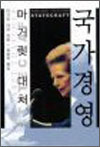
국가경영 마거릿 대처 | 김승욱 | 경영정신 | 2003.04.25
국제 정세의 주도권을 휘어잡는 국가 경영의 강력한 원칙과 리더십! 9.11테러 이후, 개전 3주일 만에 미.영 연합군의 승리로 끝난 이라크전쟁은 강대국들에 의해 주도되는 세계질서의 냉혹한 현실을 전 세계에 명확하게 각인시켜주었다.
또한 ...
Margaret Hilda Thatcher, Baroness Thatcher
Born in Grantham in Lincolnshire, England, and went on to read Chemistry at Somerville College, Oxford. She was selected as Conservative candidate for Finchley in 1958 and took her seat in the House of Commons the following year. Upon the election of Edward Heath in 1970, Thatcher was appointed Secretary of State for Education and Science. In 1974, she backed Sir Keith Joseph for the Conservative party leader, but after falling short he dropped out of the race. Thatcher entered herself and became leader of the Conservative party in 1975. Among other things, she defiantly opposed the Soviet Union, and her tough-talking rhetoric gained her the nickname the "Iron Lady". As the Conservative party maintained leads in most polls, Thatcher went on to become Britain's Prime Minister in the 1979 General Election.
Thatcher's tenure as Prime Minister was the longest since that of Lord Salisbury and was the longest continuous period in office since the tenure of Lord Liverpool who was Prime Minister in the early 19th century. She was the first woman to lead a major political party in the UK, and the first of only three women to have held any of the four great offices of state. She currently has a life peerage as Baroness Thatcher, of Kesteven in the County of Lincolnshire, which entitles her to sit in the House of Lords. During her tenure as Prime Minister she was said to need just four hours sleep a night.
Early life and education
Margaret Hilda Roberts was born on the 13 October 1925 to Alfred Roberts, originally from Northamptonshire, and Beatrice Stephenson Roberts from Lincolnshire. Thatcher spent her childhood in the town of Grantham in Lincolnshire, where her father owned two grocery shops[citation needed]. She and her older sister Muriel (1921–2004) were raised in the flat above the larger of the two located near the railway line. Her father was active in local politics and religion, serving as an Alderman and Methodist lay preacher. He came from a Liberal family but stood—as was then customary in local government—as an Independent. He lost his post as Alderman in 1952 after the Labour Party won its first majority on Grantham Council in 1950.
Margaret was brought up a devout Methodist and has remained a Christian throughout her life. After attending Huntingtower Road Primary School, she received a scholarship and attended Kesteven and Grantham Girls' School. Her school reports show hard work and commitment, but not brilliance. Outside the classroom she played hockey and also enjoyed swimming and walking. Finishing school during the Second World War, she subsequently applied for a scholarship to attend Somerville College, Oxford and was only successful when the winning candidate dropped out. She went to Oxford in 1944 and studied Chemistry, specifically crystallography. She became President of the Oxford University Conservative Association in 1946, the third woman to hold the post, and graduated from Oxford in 1947.
Following graduation, Margaret moved to Colchester and worked as a research chemist for BX Plastics. During this time she joined the local Conservative Association and attended the party conference at Llandudno[citation needed] in 1948, as a representative of the University Graduate Conservative Association. She was also a member of the Association of Scientific Workers. In January 1949, a friend from Oxford, who was working for the Dartford Conservative Association, told her that they were looking for candidates. After a brief period, she was selected as the Conservative candidate, and she subsequently moved to Dartford to stand for election as a Member of Parliament. To support herself during this period, she went to work for J. Lyons and Co., where she helped develop methods for preserving ice cream and was paid £500 per year.
Political career between 1950 and 1970
At the 1950 and 1951 elections, she fought the safe Labour seat of Dartford. Although she was unsuccessful in winning the seat she did reduce the labour majority in the constituency by 6,000. She was at the time the youngest ever female Conservative candidate and her campaign attracted a higher than normal amount media attention for a first time candidate. While active in the Conservative Party in Kent, she met Denis Thatcher, whom she married in 1951. Denis was a wealthy divorced businessman (whose first wife coincidentally had also been named Margaret) and he funded his wife's studies for the Bar. She qualified as a barrister in 1953 specialising in tax law. In the same year her twin children Carol and Mark were born.
Thatcher then began to look for a safe Conservative seat and was narrowly rejected as candidate for Orpington in 1954. She was subsequently not a candidate in the 1955 election and spent her time practising law. She had several other rejections before being selected for Finchley in April 1958. She won the seat after hard campaigning, in the 1959 election and was elected as a a member of Parliament. Her maiden speech was in support of her Private Member's Bill (Public Bodies (Admission to Meetings) Act 1960) to force local councils to hold meetings in public, which was successful. In 1961 she went against the Conservative Party's official position by voting for the restoration of birching.
She was given early promotion to the front bench as Parliamentary Secretary at the Ministry of Pensions and National Insurance in September 1961, retaining the post until the Conservatives lost power in the 1964 election. When Sir Alec Douglas-Home stepped down, Thatcher voted for Edward Heath in the leadership election over Reginald Maudling, and was rewarded with the job of Conservative spokesman on Housing and Land. In this role she adopted the policy of allowing tenants to buy their council houses, an idea first developed by her colleague James Allason. The policy would prove popular. She moved to the Shadow Treasury team after 1966.
Thatcher was one of few Conservative MPs to support Leo Abse's Bill to decriminalise male homosexuality, and she voted in favour of David Steel's Bill to legalise abortion. She supported the retention of capital punishment and voted against the relaxation of divorce laws. Thatcher made her mark as a conference speaker in 1966 with a strong attack on the high-tax policies of the Labour Government as being steps "not only towards Socialism, but towards Communism". She won promotion to the Shadow Cabinet as Shadow Fuel spokesman in 1967, and was then promoted to shadow Transport and, finally, Education before the 1970 election.
In Heath's Cabinet
When the Conservative party under Edward Heath won the 1970 general election, Thatcher became Secretary of State for Education and Science. In her first months in office, forced to administer a cut in the Education budget, she was responsible for the abolition of universal free milk for school-children aged seven to eleven (Labour had already abolished it for secondary schools). This provoked a storm of public protest, and led to one of the more unflattering names for her: "Thatcher Thatcher, Milk Snatcher". However, she also successfully resisted the introduction of library book charges.
Her term was marked by support for several proposals for more local education authorities to close grammar schools and adopt comprehensive secondary education; support for this change in education policy was not restricted to the left. Thatcher also saved the Open University from being abolished. The Chancellor Anthony Barber wanted to abolish it as a budget-cutting measure, as he viewed it as a gimmick by Harold Wilson. Thatcher believed it was a relatively inexpensive way of extending higher education and insisted that the University should experiment with admitting school-leavers as well as adults. In her memoirs, Thatcher wrote that she was not part of Heath's inner circle, and had little or no influence on the key government decisions outside her department.
After the Conservative defeat in February 1974, Heath appointed her Shadow Environment Secretary. In this position she promised to abolish the rating system that paid for local government services, which proved a popular policy within the Conservative Party.
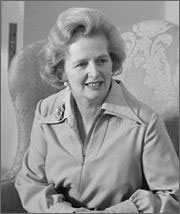 | ||
| ▲ Margaret Thatcher elected as Leader of the Opposition on 18 September 1975. | ||
As Leader of the Opposition
Margaret Thatcher elected as Leader of the Opposition on 18 September 1975.Thatcher greed with Sir Keith Joseph and the Centre for Policy Studies that the Heath Government had lost control of monetary policy—and had lost direction—following its 1972 U-turn.
After her party lost the second election of 1974, Joseph decided to challenge Heath's leadership but later withdrew after an unwise speech seen as supporting eugenics. Thatcher then decided that she would enter the race on behalf of the Josephite/CPS faction.
Unexpectedly she out-polled Heath on the first ballot, forcing him to resign the leadership. On the second ballot, she defeated Heath's preferred successor William Whitelaw, by 146 votes to 79, and became Conservative Party leader on 11 February 1975. She appointed Whitelaw as her deputy. Heath remained disenchanted with Thatcher to the end of his life for what he (and many of his supporters) perceived as her disloyalty in standing against him.
On 19 January 1976, she made a speech in Kensington Town Hall in which she made a scathing attack on the Soviet Union. The most famous part of her speech ran:
“ The Russians are bent on world dominance, and they are rapidly acquiring the means to become the most powerful imperial nation the world has seen. The men in the Soviet Politburo do not have to worry about the ebb and flow of public opinion. They put guns before butter, while we put just about everything before guns.”
In response, the Soviet Defence Ministry newspaper Krasnaya Zvezda (Red Star) gave her the nickname "Iron Lady", which was soon publicised by Radio Moscow. She took delight in the name and it soon became associated with her image as having an unwavering and steadfast character. Her reaction to her other chief nickname, "Attila the Hen" (thought to have been coined by Tory grandee Sir Ian Gilmour) is unrecorded.
Thatcher appointed many of Heath's supporters to the Shadow Cabinet, for she had won the leadership as an outsider and had little power base of her own within the party. One, James Prior got the important brief of shadow Employment Secretary. Thatcher had to act cautiously to convert the Conservative Party to her monetarist beliefs.
She reversed Heath's support for devolved government for Scotland. In an interview for Granada Television's World in Action programme in January 1978, she said "people are really rather afraid that this country might be rather swamped by people with a different culture", arousing particular controversy at the time. Critics regarded the comment as a veiled ference to people of colour—and thus pandering to xenophobia and reactionary sentiment. She received 10,000 letters thanking her for raising the subject and the Conservatives gained a lead against Labour in the opinion polls, from both parties at 43% before the speech to 48% for Conservative and 39% for Labour immediately after.
The Labour Government ran into difficulties with the industrial disputes, strikes, increasing unemployment, and collapsing public services during the winter of 1978–79, dubbed the "Winter of Discontent". The Conservatives used campaign posters with slogans such as "Labour Isn't Working" to attack the government's record over unemployment and its over-regulation of the labour market. James Callaghan's Labour government fell after a successful Motion of No Confidence in spring 1979.
In the run up to the 1979 General Election, most opinion polls showed that voters preferred James Callaghan as Prime Minister even as the Conservative Party maintained a lead in the polls. The Conservatives would go on to win a 44-seat majority in the House of Commons and Margaret Thatcher became the United Kingdom's first female Prime Minister. Arriving at 10 Downing Street, she said, in a paraphrase of St. Francis of Assisi:
“ Where there is discord, may we bring harmony. Where there is error, may we bring truth. Where there is doubt, may we bring faith. And where there is despair, may we bring hope. ”
Prime Minister (1979–1990)
Main article: Premiership of Margaret Thatcher
Thatcher became Prime Minister on 4 May 1979, with a mandate to reverse the UK's economic decline and to reduce the role of the state in the economy. Thatcher was incensed by one contemporary view within the Civil Service, that its job was to manage the UK's decline from the days of Empire, and she wanted the country to assert a higher level of influence and leadership in international affairs. She became a very close ally, philosophically and politically, with President Ronald Reagan, elected in 1980 in the United States.
Domestic reforms
Irish hunger strike
Main article: 1981 Irish hunger strike
In 1981, a number of Irish Republican Army (IRA) and Irish National Liberation Army prisoners in Northern Ireland's Maze Prison (known by most Irish people as 'Long Kesh', due to its previous official name) went on hunger strike to regain the status of political prisoners, which had been revoked five years earlier under the preceding Labour government.
Bobby Sands, the first of the strikers, was elected as a Member of Parliament (MP) for the constituency of Fermanagh and South Tyrone a few weeks before he died. Thatcher refused at first to countenance a return to political status for republican prisoners, famously declaring "Crime is crime is crime; it is not political." Nevertheless, after nine more men had starved themselves to death and the strike had ended, some rights relating to political status were restored to paramilitary prisoners. Thatcher's public hard line on the treatment of paramilitaries was reinforced during the 1980 Iranian Embassy Siege where for the first time in 70 years British armed forces were authorised to use lethal force in Great Britain.
On 15 November 1985, Thatcher signed the Hillsborough Anglo-Irish Agreement with Irish Taoiseach Garret FitzGerald, the first time a British government gave the Republic of Ireland a say (albeit advisory) in the governance of Northern Ireland. The agreement was greeted with fury by Northern Irish unionists.
Economy
Thatcher took over three years after the James Callaghan Government had concluded that the Keynesian approach to demand-side management failed to do everything, realising that as the economy is not self-righting and that new fiscal judgements had to be made to concentrate on inflation, a view accepted by the Thatcher Government . As a monetarist, Thatcher began her economic reforms by increasing interest rates to slow the growth of the money supply and thus lower inflation. It has been argued that that this heavy reliance of government control of money supply was partly responsible for the failing of early Monetarist approaches to macroeconomic management .
Thatcher had a preference for indirect taxation over taxes on income, and value added tax (VAT) was raised sharply to 15%, with a resultant actual short-term rise in inflation.These moves hit businesses – especially the manufacturing sector – and unemployment quickly passed two million, doubling the one million unemployed under the previous Labour government.
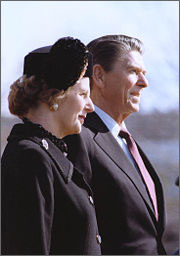 | ||
| ▲ Thatcher with close ally and friend, United States President Ronald Reagan, 1981 | ||
Thatcher's political and economic philosophy emphasised reduced state intervention, free markets, and entrepreneurialism. After the 1983 election, the Government sold off most of the large utilities, starting with British Telecom, which had been in public ownership since the late 1940s.
Many people took advantage of share offers, although many sold their shares immediately for a quick profit and therefore the proportion of shares held by individuals rather than institutions did not increase. The policy of privatisation, while anathema to many on the Left, has become synonymous with Thatcherism. Wider share-ownership and council house sales became known as "popular capitalism" to its supporters (a term coined by John Redwood). In 1985, as a deliberate snub, the University of Oxford voted to refuse her an honorary degree in protest against her cuts in funding for higher education. This award had always previously been given to all Prime Ministers who had been educated at Oxford.
Political commentators harked back to the Heath Government's "U-turn" and speculated that Thatcher would follow suit, but she repudiated this approach at the 1980 Conservative Party conference, telling the party: "To those waiting with bated breath for that favourite media catch-phrase—the U-turn—I have only one thing to say: you turn if you want to; the Lady's not for turning." That she meant what she said was confirmed in the 1981 budget, when, despite concerns expressed in an open letter from 364 leading economists, taxes were increased in the middle of a recession. In January 1982, the inflation rate had dropped back to 8.6% from earlier highs of 18%, and interest rates were then allowed to fall. Unemployment continued to rise, reaching an official figure of 3.6 million. By 1983, manufacturing output had dropped 30% from 1978, while overall economic growth was stronger, and inflation and mortgage rates were at their lowest levels since 1970.
At the Dublin European Council in November 1979, Thatcher argued that the United Kingdom paid far more to the European Economic Community than it received in spending. She declared at the summit: "We are not asking the Community or anyone else for money. We are simply asking to have our own money back". Her arguments were successful and at the June 1984 Fontainebleau Summit, the EEC agreed on an annual rebate for the United Kingdom, amounting to 66% of the difference between Britain's EU contributions and receipts. This still remains in effect, although Tony Blair later agreed to significantly reduce the size of the rebate. It periodically causes political controversy among the members of the European Union.
Thatcher's new system to replace local government taxes, outlined in the Conservative manifesto for the 1987 election, was introduced in Scotland in 1989 and in England and Wales in 1990. The rates were replaced by the Community Charge or 'Poll Tax', which applied the same amount to every individual resident, with discounts for low earners. This was to be the most universally unpopular policy of her premiership. Individuals seeking to avoid paying their share of the costs of local government effectively disenfranchised themselves by removing themselves from the electoral register.
Thatcher's popularity declined in 1989, as the economy suffered from high interest rates. She blamed her Chancellor, Nigel Lawson, who had been following an economic policy which was a preparation for monetary union; in an interview for the Financial Times, in November 1987, Thatcher claimed not to have been told of this and did not approve.
At a meeting before the Madrid European Community summit in June 1989, Lawson and Foreign Secretary Geoffrey Howe persuaded Thatcher to agree to the circumstances under which she would join the Exchange Rate Mechanism, a preparation for monetary union and the abolition of the Pound Sterling. At the meeting, they both said they would resign if their demands were not met. Thatcher responded by demoting Howe and by listening more to her adviser Sir Alan Walters on economic matters. Lawson resigned that October, feeling that Thatcher had undermined him.
Additional problems emerged when many of the tax rates set by local councils proved to be much higher than predicted. Opponents of the Community Charge banded together to resist bailiffs and disrupt court hearings of Community Charge debtors. The Labour MP, Terry Fields, was jailed for 60 days for refusing on principle to pay his Community Charge. As the Prime Minister continued to refuse to compromise on the tax and as many as one in five people had still not paid, unrest mounted and culminated in a number of riots. The most serious of these happened in London on 31 March 1990, during a protest at Trafalgar Square, London, which more than 100,000 protesters attended. The huge unpopularity of the tax was seen as a major factor in Thatcher's downfall.
On the Friday before the Conservative Party conference in October 1990, Thatcher ordered her new Chancellor of the Exchequer John Major to reduce interest rates by 1%. Major persuaded her that the only way to maintain monetary stability was to join the Exchange Rate Mechanism at the same time, despite not meeting the "Madrid conditions". The Conservative Party conference that year saw a large degree of unity.
Trade unions
Thatcher was committed to reducing the power of the trades unions. Several unions launched strikes in response to legislation introduced to curb their power, but these actions eventually collapsed, and gradually Thatcher's reforms reduced the power and influence of the unions.
In 1982 the National Union of Mineworkers accepted a Government offer of a 9.3 percent raise, rejecting their leaders' call for a strike authorization.
The confrontation over strikes, ordered illegally without a national ballot in 1984–85 by the National Union of Mineworkers (NUM) in opposition to proposals to close a large number of mines, proved decisive. Police tactics during the strikes came under criticism from civil libertarians,[citation needed] but the images of crowds of militant miners attempting to prevent other miners from working proved a shock even to some supporters of the strikes.
Two miners, Dean Hancock and Russell Shankland, were convicted of the murder of David Wilkie, a taxi driver, whom they killed by throwing a 46 pounds (21 kg) slab of concrete through the windscreen of his car from a bridge as he drove beneath it. He was driving a colleague of theirs, David Williams, to work. Both were sentenced to life imprisonment.
A group of workers, resigned to the impending failure of the actions, worn down by months of protests, and angry at the NUM's failure to hold a national strike ballot, began to defy the Union's rulings, starting splinter groups and advising workers that returning to work was the only viable option. The Miners' Strike lasted a full year before the NUM leadership conceded without a deal. The Conservative government proceeded to close all but 15 of the country's pits, with the remaining 15 being sold off and privatised in 1994. The defeat of the miners' strike led to a long period of demoralization in the whole of the trade union movement.
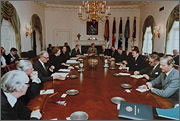 | ||
| ▲ Thatcher's Ministry meets with Reagan's Cabinet at the White House, 1981 | ||
South African controversy
Thatcher's Ministry meets with Reagan's Cabinet at the White House, 1981At the end of March 1984, four South Africans were arrested in Coventry, remanded in custody, and charged with contravening the UN arms embargo, which prohibited exports to apartheid South Africa of military equipment.
Thatcher took a personal interest in the Coventry Four, and 10 Downing Street requested daily summaries of the case from the prosecuting authority, HM Customs and Excise. Within a month, the Coventry Four had been freed from jail and allowed to travel to South Africa—on condition that they returned to England for their trial later that year.
In April 1984, Thatcher sent senior British diplomat, Sir John Leahy, to negotiate the release of 16 Britons who had been taken hostage by the Angolan rebel leader, Jonas Savimbi. At the time, Savimbi's UNITA guerrilla movement was financed and supported militarily by the apartheid regime of South Africa.
On 26 April 1984, Leahy succeeded in securing the release of the British hostages at the UNITA base in Jamba, Angola. In June 1984 Thatcher invited apartheid South Africa's president, P. W. Botha, and foreign minister, Pik Botha, to Chequers in an effort to stave off growing international pressure for the imposition of economic sanctions against South Africa, where Britain had invested heavily.
She reportedly urged President Botha to end apartheid; to release Nelson Mandela; to halt the harassment of black dissidents; to stop the bombing of African National Congress (ANC) bases in front-line states; and to comply with UN Security Council resolutions and withdraw from Namibia. However Botha ignored these demands.
In an interview with Hugo Young for The Guardian in July 1986, Thatcher expressed her belief that economic sanctions against South Africa would be immoral because they would make thousands of black workers unemployed. In August 1984, foreign minister, Pik Botha, decided not to allow the Coventry Four to return to stand trial, thereby forfeiting £200,000 bail money put up by the South African embassy in London. The Coventry Four affair, and Thatcher's alleged involvement in it, would hit the headlines four years later when British diplomat, Patrick Haseldine, wrote a letter to the Guardian newspaper on 7 December 1988.
Brighton bombing
On the early morning of 12 October 1984, the day before her 59th birthday, Thatcher escaped injury in the Brighton hotel bombing during the Conservative Party Conference when her hotel room was bombed by the Provisional Irish Republican Army; five people died in the attack. A prominent member of the Cabinet, Norman Tebbit, was injured, and his wife Margaret was left paralysed. Thatcher herself would have been injured if not for the fact that she was delayed from using the bathroom (which suffered more damage than the room she was in at the time the bomb detonated). Thatcher insisted that the conference open on time the next day and made her speech as planned in defiance of the bombers, a gesture which won widespread approval across the political spectrum.
Relationship with Labour party
In 1986, her government controversially abolished the Greater London Council, then led by the strongly left-wing Ken Livingstone, and six Metropolitan County Councils. The government claimed this was an efficiency measure. However, Thatcher's opponents held that the move was politically motivated, as all of the abolished councils were controlled by Labour, had become powerful centres of opposition to her government, and were in favour of higher local government taxes and public spending. Several of them had however rendered themselves politically vulnerable by committing scarce public funds to causes widely seen as political and even extreme.
Elections
1983
The "Falklands Factor", along with an economic recovery in early 1983, bolstered the government's popularity. The Labour party at this time had split, and there was a new challenge in the SDP-Liberal Alliance, formed by an electoral pact between the Social Democratic Party and the Liberal Party. However, this grouping failed to make its intended breakthrough, despite briefly holding an opinion poll lead.[citation needed] In the June 1983 general election, the Conservatives won 42.4% of the vote, the Labour party 27.6% and the Alliance 25.4% of the vote. Although the Conservatives' share of the vote had fallen slightly (1.5%) since 1979, Labour's vote had fallen by far more (9.3%) and in Britain's first past the post system, the Conservatives won a landslide victory even though it had the support of less than 43% of the electorate. This resulted in the Conservative Party having an overall majority of 144 MPs.
1987
By leading her party to victory in the 1987 general election with a 101 seat majority, riding an economic boom against a weak Labour opposition advocating unilateral nuclear disarmament, Margaret Thatcher became the longest continuously serving Prime Minister of the United Kingdom since Lord Liverpool (1812 to 1827). Most United Kingdom newspapers supported her—with the exception of The Daily Mirror, The Guardian, The Observer and The Independent—and were rewarded with regular press briefings by her press secretary, Bernard Ingham.
1989
Thatcher was challenged for the leadership of the Conservative Party by Sir Anthony Meyer. As Meyer was a virtually unknown backbench MP, he was viewed as a "stalking horse" candidate for more prominent members of the party. Thatcher easily defeated Meyer's challenge, but there were sixty ballot papers either cast for Meyer or abstaining, a surprisingly large number for a sitting Prime Minister. Her supporters in the Party, however, viewed the results as a success, claiming that after ten years as Prime Minister and with approximately 370 Conservative MPs voting, the opposition was surprisingly small.
Homosexuality
Though an early backer of decriminalization of male homosexuality, Thatcher, at the 1987 Conservative party conference, issued the statement that "Children who need to be taught to respect traditional moral values are being taught that they have an inalienable right to be gay". Backbench Conservative MPs and Peers had already begun a backlash against the 'promotion' of homosexuality and, in December 1987, the controversial 'Section 28' was added as an amendment to what became the Local Government Act 1988. This legislation was subsequently abolished by Tony Blair's Labour administration.
Foreign policy
The Falklands
Main article: Falklands War
On 2 April 1982, a ruling military junta in Argentina invaded the Falkland Islands, a British overseas territory that Argentina had claimed since an 1830s dispute on the British settlement. Within days Thatcher sent a naval task force to recapture the islands. Despite the huge logistical difficulties the operation was a success, resulting in a wave of patriotic enthusiasm and support for her government, with Newsweek declaring "The Empire Strikes Back". There were also several controversies that arose as a result of the Falklands War and Thatcher's handling of the conflict.
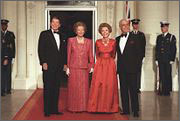 | ||
| ▲ The Thatchers with the Reagans standing at the North Portico of the White House prior to a state dinner, 16 November 1988 | ||
Cold War
In the Cold War, Mrs Thatcher supported United States President Ronald Reagan's policies of deterrence against the Soviets. This contrasted with the policy of détente which the West had pursued during the 1970s, and caused friction with allies who still adhered to the idea of détente.
US forces were permitted by Mrs. Thatcher to station nuclear cruise missiles at British bases, arousing mass protests by the Campaign for Nuclear Disarmament. However, she later was the first Western leader to respond warmly to the rise of the future reformist Soviet leader Mikhail Gorbachev, declaring that she liked him, and told Ronald Reagan, describing him as "a man we can do business with" after a meeting in 1984, three months before he came to power.
This was a start of a move by the West back to a new détente with the USSR under Gorbachev's leadership, which coincided with the final erosion of Soviet power prior to its eventual collapse in 1991. Thatcher outlasted the Cold War, which ended in 1989, and those who share her views on it credit her with a part in the West's victory, by both the deterrence and détente postures.
Her liking for defence ties with the United States was demonstrated in the Westland affair when she acted with colleagues to allow the helicopter manufacturer Westland, a vital defence contractor, to refuse to link with the Italian firm Agusta in order for it to link with the management's preferred option, Sikorsky Aircraft Corporation of the United States. Defence Secretary Michael Heseltine, who had pushed the Agusta deal, resigned in protest after this, and remained an influential critic and potential leadership challenger. He would eventually prove instrumental in Thatcher's fall in 1990.
According to Helmut Kohl, West Germany's ex-Chancellor, Margaret Thatcher was also a strong opponent of the German reunification that was developing at unexpected speed in 1989. However she failed to halt it.
Hong Kong
In 1984, she visited China and signed the Sino-British Joint Declaration with Deng Xiaoping on 19 December, which committed the People's Republic of China to award Hong Kong the status of a "Special Administrative Region". Under the terms of the One Country, Two Systems agreement, which Deng himself proposed, China agreed to leave Hong Kong's economic status unchanged after the handover on 1 July 1997 for a period of fifty years—until 2047. Britain agreed to leave, unconditionally, in 1997.
European Union
At Bruges, Belgium, in 1988, Thatcher made a speech in which she outlined her opposition to proposals from the European Community for a federal structure and increasing centralisation of decision-making. Although she had supported British membership, Thatcher believed that the role of the EC should be limited to ensuring free trade and effective competition, and feared that new EC regulations would reverse the changes she was making in the UK: "We have not successfully rolled back the frontiers of the state in Britain, only to see them re-imposed at a European level, with a European super-state exercising a new dominance from Brussels". The speech caused an outcry from other European leaders, and exposed for the first time the deep split that was emerging over European policy inside her Conservative Party.
Thatcher, the former chemist, became publicly concerned with environmental issues in the late 1980s. In 1988, she made a major speech communicating the problems of global warming, ozone depletion and acid rain. Referring to her important role in the struggle against ozone depletion, Carl Sagan claimed that she demonstrated the importance in the modern world of leaders having an understanding of science.
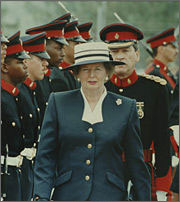 | ||
| ▲ Thatcher reviews Bermudian troops, 12 December 1990 | ||
Gulf War
Thatcher reviews Bermudian troops, 12 December 1990One of Thatcher's acts in her last half year in office was to put pressure on US President George H. W. Bush to deploy troops to the Middle East to drive Saddam Hussein's (Iraqi) army out of Kuwait. Bush was somewhat apprehensive about the plan, but Thatcher's memoirs summarise her advice to him during a telephone conversation with the words, "this was no time to go wobbly!" Thatcher's vernment provided military forces to the international coalition in the Gulf War to pursue the ouster of Iraq from Kuwait.
Fall from power
See also: Conservative Party (UK) leadership election, 1990 Thatcher's political downfall was, according to witnesses such as Alan Clark, one of the most dramatic episodes in British political history. By 1990, opposition to Thatcher's policies on local government taxation (the community charge, or poll tax), and the divisions opening in the Conservative Party over European integration made her seem increasingly politically vulnerable and her party increasingly divided. Her distaste for consensus politics and willingness to override colleagues' opinions, including that of Cabinet, emboldened the backlash against her when it did occur. The dislike for Thatcher that had previously come primarily from her political opponents was now being expressed by some members of her own party.
On 1 November 1990, Sir Geoffrey Howe, one of Thatcher's oldest and staunchest supporters, resigned from his position as Deputy Prime Minister in protest at Thatcher's European policy. In his resignation speech in the House of Commons two weeks later, he suggested that the time had come for "others to consider their own response to the tragic conflict of loyalties" with which he stated that he had wrestled for perhaps too long.
Her former cabinet colleague Michael Heseltine subsequently challenged her for the leadership of the party, and attracted sufficient support in the first round of voting to prolong the contest to a second ballot. Though she initially stated that she intended to contest the second ballot, Thatcher decided, after consulting with her Cabinet colleagues, to withdraw from the contest. On 22 November, at just after 9.30 a.m., she announced to the Cabinet that she would not be a candidate in the second ballot. Shortly afterwards, her staff made public what was, in effect, her resignation statement:
“ Having consulted widely among my colleagues, I have concluded that the unity of the Party and the prospects of victory in a General Election would be better served if I stood down to enable Cabinet colleagues to enter the ballot for the leadership. I should like to thank all those in Cabinet and outside who have given me such dedicated support. ”
Neil Kinnock, Leader of the Opposition, proposed a motion of no confidence in the government, and Margaret Thatcher seized the opportunity this presented on the day of her resignation to deliver one of her most memorable performances:
“ ...a single currency is about the politics of Europe, it is about a federal Europe by the back door. So I shall consider the proposal of the Honourable Member for Bolsover (Mr. Skinner). Now where were we? I am enjoying this. ”
She supported John Major as her successor and he duly won the leadership contest, although in the years to come her approval of Major would fall away. After her resignation a MORI poll found that 52% agreed with the proposition that "On balance she had been good for the country", while 48% disagreed, thinking she had not. In 1991, she was given a long and unprecedented standing ovation at the party's annual conference, although she politely rejected calls from delegates for her to make a speech. She did, however, occasionally speak in the House of Commons after she was Prime Minister. She retired from the House at the 1992 election, at the age of 66 years.
Post-political career
Orders and honours
Since her resignation, Thatcher has remained active in the politics of the United Kingdom, as well as the world. She was raised to the House of Lords by the conferment of a life peerage as Baroness Thatcher, of Kesteven in the County of Lincolnshire in 1992; she did not take a hereditary title[citation needed]. By virtue of the life barony, she entered the House of Lords. Thatcher had already been honoured by the Queen in 1990, shortly after her resignation as Prime Minister, when awarded the Order of Merit, one of the UK's highest distinctions. In addition, her husband, Denis Thatcher, had been given a baronetcy in 1991 (ensuring that their son Mark would inherit a title). This was the first creation of a baronetcy since 1965. In 1995, Thatcher was raised to the Order of the Garter, the United Kingdom's highest order of Chivalry.
Post-Prime Ministerial influence
Thatcher authored her memoirs in two volumes, The Path to Power and The Downing Street Years. In 1993 The Downing Street Years were turned into a documentary series by the BBC, in which she described the Cabinet rebellion that brought about her resignation as "treachery with a smile on its face".
Thatcher made a series of speeches in the Lords criticizing the Maastricht Treaty, describing it as "a treaty too far" and stated "I could never have signed this treaty". She cited A. V. Dicey, to the effect that, since all three main parties were in favour of revisiting the treaty, the people should have their say.
On 6 August 1992 she called for NATO to stop the Serbian assault on Gorazde and Sarajevo in order to end ethnic cleansing and to preserve the Bosnian state. She claimed what was happening in Bosnia was "reminiscent of the worst excesses of the Nazis," warning that there could be a "holocaust" in Bosnia and described the conflict as a "killing field the like of which I thought we would never see in Europe again."
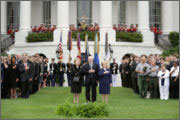 | ||
| ▲ Thatcher attends the official Washington, D.C. memorial service marking the 5th anniversary of the 9/11 terror attacks, pictured with Vice President Dick Cheney and his wife Lynne Cheney. | ||
From 1993 to 2000, she served as Chancellor of the College of William and Mary in Virginia, which, established by Royal Charter in 1693, is the sole royal foundation in the contiguous United States. She was also Chancellor of the University of Buckingham, the UK's only private university and retired from in 1998.
Although she remained supportive in public, in private she made her displeasure with many of John Major's policies plain, and her views were conveyed to the press and widely reported. She was critical of the rise in public spending under Major, his tax increases, and his support of the European Union. After Tony Blair's election as Labour Party leader in 1994, Thatcher gave an interview in May 1995 in which she praised Blair as "probably the most formidable Labour leader since Hugh Gaitskell. I see a lot of socialism behind their front bench, but not in Mr Blair. I think he genuinely has moved."
In 1998, Thatcher made an unofficial visit to the former Chilean president Augusto Pinochet, while he was under house arrest in Surrey. Pinochet was fighting extradition for human rights abuses committed during his tenure. Thatcher expressed her support and friendship for Pinochet.[58] Pinochet had been a key ally of Britain during the Falklands War. Also in 1998, she made a £2,000,000 donation to Cambridge University for the endowment of a Margaret Thatcher Chair in Entrepreneurial Studies. She also donated the archive of her personal papers to Churchill College, Cambridge where the collection continues to be expanded.
At Thatcher's first speech to a Conservative Party conference in nine years in 1999, she not only defended Pinochet's actions as Chilean president, but made some controversial remarks on a continental Europe. Her comments aroused some criticism from Malcolm Rifkind, a former Foreign Secretary under John Major, who claimed that Lady Thatcher was giving "the impression that Britain and British opinion is somehow prejudiced and anti-European".
Margaret Thatcher actively supported the Conservative general election campaign in 2001. In the Conservative leadership election shortly after, Lady Thatcher came out in support of Iain Duncan Smith because she believed he would "make infinitely the better leader" than Kenneth Clarke due to Clarke's "old-fashioned views of the role of the state and his unbounded enthusiasm for European integration".
In 2002, she published Statecraft: Strategies for a Changing World detailing her thoughts on international relations since her resignation in 1990. The chapters on the European Union were particularly controversial; she called for a fundamental renegotiation of Britain's membership to preserve the UK's sovereignty and, if that failed, for Britain to leave and join NAFTA. These chapters were serialised in The Times on Monday, 18 March and caused a political furore.
In December 2004, it was reported that Thatcher had told a private meeting of Conservative MPs that she was against the British Government's plan to introduce identity cards. She is said to have remarked that ID cards were a "Germanic concept and completely alien to this country".
Health concerns
It was annound in 2002 that Thatcher had been advised by her doctors to make no more public speeches on health grounds, having suffered several small strokes. According to her former press spokesman Bernard Ingham, Thatcher has no short-term memory as a result of the strokes.
Recent activities
Thatcher attends the official Washington, D.C. memorial service marking the 5th anniversary of the 9/11 terror attacks, pictured with Vice President Dick Cheney and his wife Lynne Cheney.
Thatcher talks with former United States Secretary of Defense Donald Rumsfeld and Chairman of the Joint Chiefs of Staff General Peter Pace, 12 September 2006Lady Thatcher was widowed upon the death of Sir Denis Thatcher on 26 June 2003. A funeral service was held honouring him at the Royal Hospital in Chelsea on 3 July with Lady Thatcher present, as well as her children Mark and Carol. Thatcher paid tribute to him by saying, "Being Prime Minister is a lonely job. In a sense, it ought to be—you cannot lead from a crowd. But with Denis there I was never alone. What a man. What a husband. What a friend".
On 11 June 2004, Thatcher attended the funeral of, and delivered a tribute via videotape to, former United States President Ronald Reagan at his state funeral at the National Cathedral in Washington, D.C. In view of her failing mental faculties following several small strokes, the message had been pre-recorded several months earlier. Thatcher then flew to California with the Reagan entourage, and attended the memorial service and interment ceremony for President Reagan at the Ronald Reagan Presidential Library.
Thatcher marked her 80th birthday with a party at the Mandarin Oriental Hotel in Hyde Park on 13 October 2005, where the guests included Queen Elizabeth II, The Duke of Edinburgh, and Princess Alexandra, The Honourable Lady Ogilvy. There, Geoffrey Howe, now Lord Howe of Aberavon, commented on her political career: "Her real triumph was to have transformed not just one party but two, so that when Labour did eventually return, the great bulk of Thatcherism was accepted as irreversible."
To commemorate the September 11th terror attacks on the United States, Thatcher attended the official Washington, D.C. memorial service marking the 5th anniversary. She attended as a guest of the US Vice President, Dick Cheney, and met with US Secretary of State Condoleezza Rice during her visit. Thatcher was last in the United States for the funeral of former US Secretary of Defense Caspar Weinberger in April 2006.
On 12 November 2006, she appeared at the Remembrance Day parade at the Cenotaph in London, leaning heavily on the arm of former Prime Minister, John Major. One week later, she released an effusive statement of condolence on the death of her friend and economic mentor, Milton Friedman, the man often described as the inspiration behind Thatcherism. On 10 December she announced she was "deeply saddened" by the death of the former Chilean dictator General Pinochet.
A statue of Lady Thatcher was unveiled in the British Houses of Parliament on 21 February 2007. Thatcher made a rare and brief speech in the members' lobby of the House of Commons. She gibed, "I might have preferred iron—but bronze will do... It won't rust. And, this time I hope, the head will stay on" (a previous statue in stone had been attacked and decapitated while on public exhibition).
On 13 September 2007, Lady Thatcher was invited to 10 Downing Street to have tea with Prime Minister Gordon Brown and his wife, Sarah. Gordon Brown referred to Lady Thatcher as a "conviction politician." and said of himself, "I'm a conviction politician just like her." However William Hague attacked this decision, saying to Gordon Brown:
“ You may fawn now at the feet of our greatest prime minister – but you are no Margaret Thatcher. Margaret Thatcher would never have devastated the pension funds of this nation, nor kicked its small businesses in the teeth. We, Gordon, backed her when she rescued our country in the face of every denunciation and insult from the likes of you.”
Brown's spokesman, however, denied these claims and insisted that the meeting was "not unusual", it was customary for Prime Ministers to invite their precedents to tea and that Mr Brown would be "happy" to meet any former Prime Minister.
On Thursday 30 January 2008, Lady Thatcher met with the incumbent Tory Leader, David Cameron MP at an awards ceremony at London's Guildhall where she was presented with a 'Lifetime Acheivement Award'.
Legacy
Thatcher is well remembered for her famed remark "There is no such thing as society" to the reporter Douglas Keay, for Woman's Own magazine, 23 September 1987. This remark has frequently been quoted out of its full context and the surrounding remarks were as follows:
I think we've been through a period where too many people have been given to understand that if they have a problem, it's the government's job to cope with it. 'I have a problem, I'll get a grant.' 'I'm homeless, the government must house me.' They're casting their problem on society. And, you know, there is no such thing as society. There are individual men and women, and there are families. And no government can do anything except through people, and people must look to themselves first.
In 1996, the Scott Inquiry into the Arms-to-Iraq affair investigated the Thatcher government's record in dealing with Saddam Hussein. It revealed how £1bn of Whitehall money was used in soft loan guarantees for British exporters to Iraq. The judge found that during Baghdad's protracted invasion of Iran in the 1980s, officials destroyed documents relating to the export of Chieftain tank parts to Jordan which ended up in Iraq. Ministers clandestinely relaxed official guidelines to help private companies sell machine tools which were used in munitions factories. The British company Racal exported sophisticated Jaguar V radios to the former Iraqi dictator's army on credit. Members of the Conservative cabinet refused to stop lending guaranteed funds to Saddam even after he executed a British journalist, Farzad Bazoft, Thatcher’s cabinet minuting that they did not want to damage British industry.
New Labour and Blairism have incorporated much of the economic, social and political tenets of "Thatcherism" in the same manner as, in a previous era, the Conservative Party from the 1950s until the days of Edward Heath accepted many of the basic assumptions of the welfare state instituted by Labour governments. The curtailing and large-scale dismantling of elements of the welfare state under Thatcher have largely remained. Among others, Thatcher's program of privatising state-owned enterprises has not been reversed. Indeed, successive Tory and Labour governments have further curtailed the involvement of the state in the economy and have further dismantled public ownership.
Thatcher's impact on the trade union movement in Britain has been lasting, with the breaking of the miners' strike of 1984-1985 seen as a watershed moment, or even a breaking point, for a union movement which has been unable to regain the degree of political power it exercised up through the 1970s. Unionisation rates in Britain have permanently declined since the 1980s, and the legislative instruments introduced to curtail the impact of strikes have not been reversed. The Labour Party has worked to loosen its ties to the trade union movement[citation needed]. Although the power of trade unions is still significantly lower than it was before Thatcher came to power, the Employment Relations Act 2004 was introduced under the Blair government to make statutory recognition of trade unions accessible and to further protect workers taking industrial action.
Thatcher's legacy has continued to strongly influence the Conservative Party itself. Successive leaders, starting with John Major, and continuing in opposition with William Hague, Iain Duncan Smith and Michael Howard, have struggled with real or perceived factions in the Parliamentary and national party to determine what parts of her heritage should be retained or jettisoned. One cannot yet determine what the role of Thatcherism will be under the leadership of David Cameron.
Thatcher is credited by Ronald Reagan with persuading him that Mikhail Gorbachev was sincere in his desire to reform and liberalize the Soviet Union. The resulting thaw in East-West relations helped to end the Cold War. In recognition of this, Lady Thatcher was awarded the 1998 Ronald Reagan Freedom Award by Mrs. Nancy Reagan. President Ronald Reagan, who was not able to attend the ceremony, was a longtime friend of Lady Thatcher.
In a list compiled by New Statesman in 2006, she was voted fifth in the list of "Heroes of our time". She was also named a "Hero of Freedom" by the libertarian magazine Reason.
In February 2007, she became the first Prime Minister of the United Kingdom to be honoured with a statue in the House of Commons while still alive. The statue is made of bronze and stands opposite her political hero and predecessor, Winston Churchill. The statue, by sculptor Antony Dufort, shows her as if she were addressing the House of Commons, with her right arm outstretched. Thatcher said she was thrilled with it.
In March, 2007, Variety reported that the makers of the Oscar-winning drama The Queen were planning a film on Thatcher's days leading up to the Falklands War. As of late summer 2007, no stars have been attached to the project, which is still in planning stages.

뉴스타운
뉴스타운TV 구독 및 시청료 후원하기
뉴스타운TV





![[단독] 북한산 인수봉, 구조 헬기 긴급 출동 장면 포착!](/news/photo/202511/669971_628773_447.jpg)